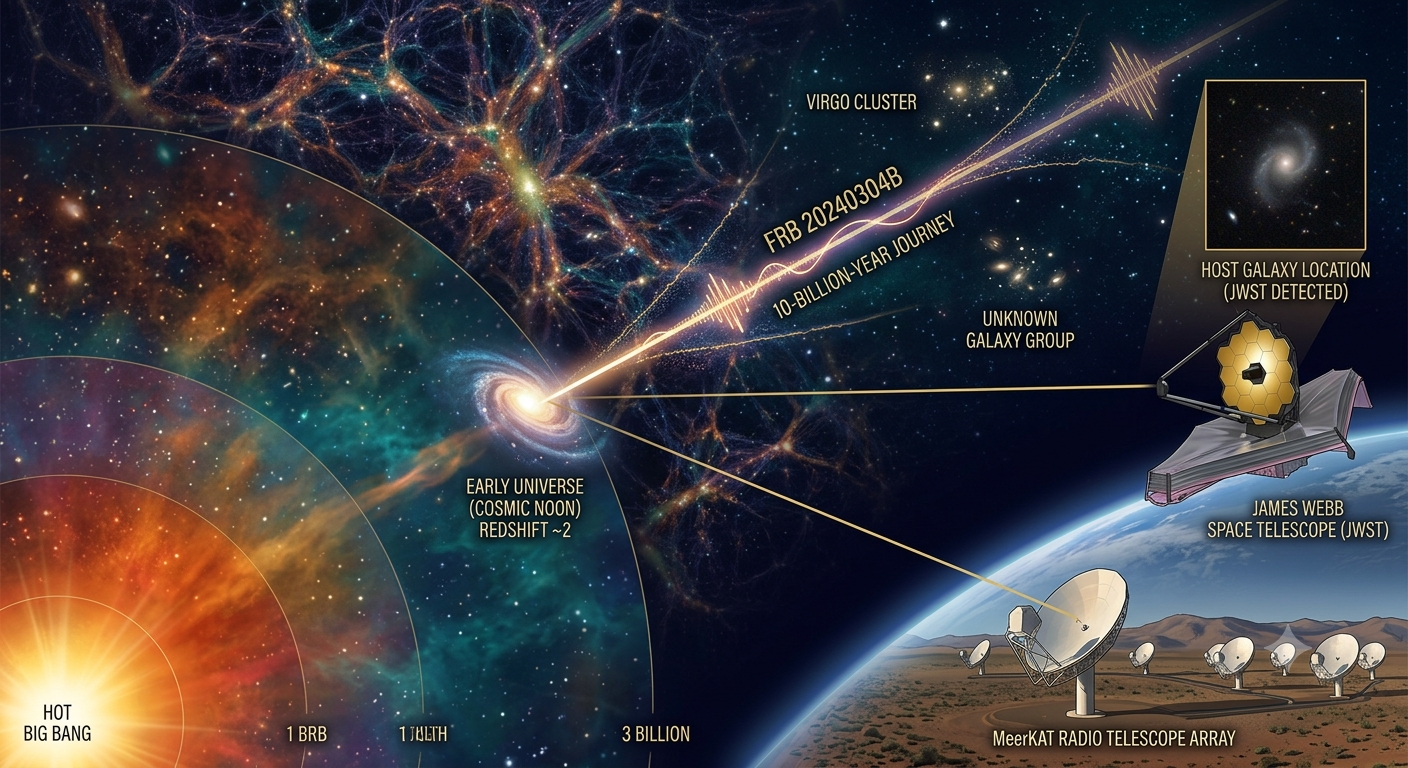
Astronomers using the James Webb Space Telescope have traced the most distant fast radio burst ever found – by using FRB 20240304B back to a tiny dwarf galaxy from the dawn of time, offering fresh clues about the universe’s most elusive signals.

If you stood outside on a pitch-black night, looking up at the vast expanse of the cosmos, you’d be forgiven for thinking the universe is a quiet, orderly place. But beneath that peaceful veneer, the universe is punctuated by violent, fleeting ghosts.
They are called Fast Radio Bursts (FRBs) – millisecond-long flashes of blinding radio energy that erupt from deep space, release the power of hundreds of millions of suns, and vanish almost as quickly as they appear. Since their discovery nearly two decades ago, they have haunted astronomers. Where do they come from? What catastrophic event packs enough punch to send a radio wave across the ocean of space to our tiny blue dot?
Now, we are one step closer to an answer.
In a landmark astronomical breakthrough, an international team of researchers has detected, localized, and analyzed FRB 20240304B the most distant fast radio burst ever recorded. Traveling across roughly 80 percent of the universe’s history, this ancient signal took an astonishing 10 billion years to reach us, echoing from a time when the universe was barely 3 billion years old.
And the plot thickens: the home galaxy that gave birth to this signal completely caught scientists off guard.
The Hunt: From South African Skies to Space-Age Infrared
Catching a ghost is never easy. The journey of discovery began on March 4, 2024, when the MeerTRAP team – led by Dr. Manisha Caleb and Dr. Themiya Nanayakkara from the University of Sydne – spotted the transient flash using the MeerKAT radio telescope array in South Africa.
The initial radio data carried a tantalizing hint: this signal was impossibly far away. But to prove it, astronomers needed to find its “host galaxy“- the stellar neighborhood from which the flash originated.
Read More: Solar Plexus Chakra
Here is where the mystery deepened. When researchers pointed the world’s most powerful ground-based optical telescopes at the exact coordinates of the burst, they found absolute darkness. Nothing was there. To an optical telescope, the galaxy simply didn’t exist.
Refusing to hit a dead end, the team called in the heavy artillery: the James Webb Space Telescope (JWST). Armed with unprecedented infrared sensitivity (via its NIRCam and NIRSpec instruments), Webb peered into the abyss and finally captured a glimpse of the phantom host galaxy. Spectroscopic analysis revealed a staggering cosmological redshift of 2.148, confirming that the signal had been hurtling through space since an era known as “cosmic noon”- the peak period of star formation in the early universe.
Expecting a Monster, Finding a Mouse
When you imagine an energetic event capable of projecting a radio signal across 10 billion light-years, your mind naturally pictures a titanic, sprawling galaxy churning with billions of ancient stars.
The reality? Astronomers found themselves looking at a mouse instead of a monster.
The host galaxy of FRB 20240304B turned out to be a tiny dwarf galaxy, a staggering 1,000 times less massive than scientists expected. Even more fascinating, it is exceedingly young; roughly 90% of its stellar population was forged in a frantic, explosive burst of star birth that lasted a mere 30 million years.
This unexpected discovery serves as a massive clue in the ongoing detective work of identifying what causes FRBs. For years, astrophysicists have debated nearly 100 theoretical models, with two main suspects leading the pack:
1. Neutron Star Mergers: The violent collision of two dead, dense stellar remnants. However, these systems take billions of years to spiral inward and crash—meaning they belong in older, mature galaxies, not a newborn dwarf galaxy.
2. Young Magnetars:Highly magnetized neutron stars born from the explosive death (supernova) of massive stars. Because magnetars can form and ignite almost immediately after a star dies, they fit the profile of a young, rapid star-forming galaxy like a glove.
By process of elimination, this discovery heavily shifts the weight of evidence away from mergers and places it firmly on young magnetars as the cosmic culprits behind these mysterious flashes.
The Universe’s Ultimate “Cosmic Flashlight”
What makes FRB 20240304B so monumental isn’t just that it broke distance record – it’s what it brought with it on the journey.
As light travels across a vacuum, it travels uninhibited. But as this fast radio burst traversed 10 billion years of space, it had to pass through clouds of ionized gas, plasma, and cosmic structures. Just like a flashlight beam cutting through fog, the radio wave picked up the “imprints” of everything it touched. Lower-frequency waves were subtly slowed and scattered differently than higher-frequency ones.
By decoding this cosmic fingerprint, astronomers were able to map out invisible matter along the way, including an unknown galaxy cluster residing 3.5 billion light-years away, as well as the ionic signature of our own local neighbor, the Virgo Cluster. In essence, the FRB acted as a cosmic surveyor, illuminating the invisible web of matter that weaves the universe together.
What Lies Ahead?
The detection of FRB 20240304B marks a watershed moment for modern astrophysics. It proves that we can look further back into the universe’s infancy than ever before, using transient radio waves as our guides and the James Webb Space Telescope as our magnifying glass.
As new radio arrays come online and telescope technology continues to advance, astronomers are gearing up to find many more of these ancient beacons. Every flash brings us one step closer to pulling back the curtain on the universe’s most elusive energies—reminding us that even after millennia of looking up at the stars, the cosmos still knows how to keep a secret.