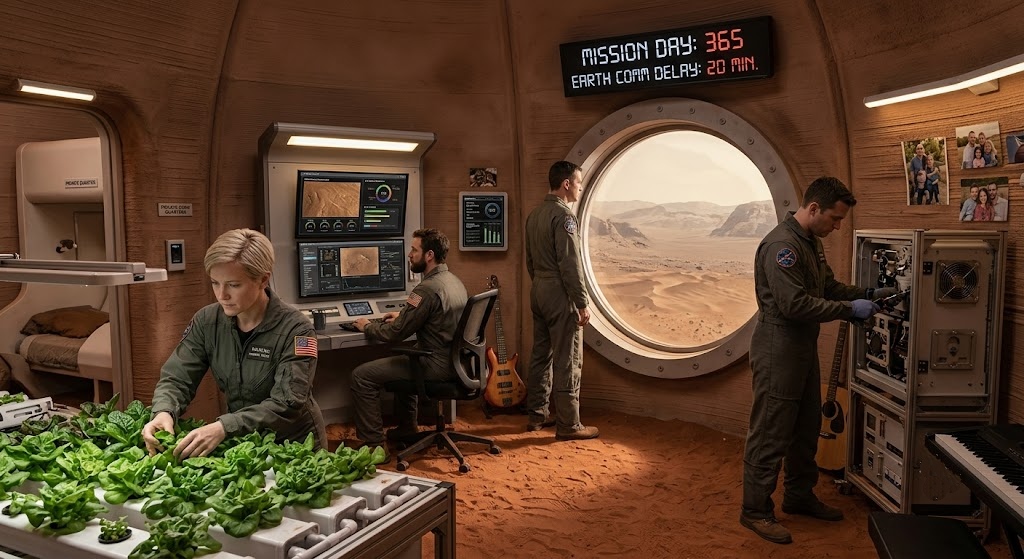
NASA’s simulated Mars crew marks one year inside their 3D-printed habitat, yielding vital insights into human health and autonomy for deep space missions.
Introduction: A Milestone in Deep Space Simulation
For as long as humanity has gazed up at the rusty crimson orb of Mars, we have dreamed of walking upon its dusty plains. Yet, the chasm between looking at a celestial body and standing on it is vast, fraught with monumental engineering, logistical, and biological challenges. Among the most complex variables in this cosmic equation is the human element. How do four distinct individuals cope with over a year of absolute isolation? How does prolonged confinement, coupled with resource scarcity and delayed communication, affect cognitive performance, group dynamics, and psychological well-being?
To answer these critical questions, NASA has turned to ground-based analogs that mimic the stark realities of deep space exploration. Recently, the four dedicated crew members participating in NASA’s Crew Health and Performance Exploration Analog (CHAPEA) Mission 2 marked a monumental milestone: one full year living and working entirely inside a simulated Mars habitat.
Read More: SpaceX Launches Bandwagon-5 Mission from Cape Canaveral, Sparking ‘Space Jellyfish’ in Florida Sky
Stationed at NASA’s Johnson Space Center in Houston, Texas, commander Ross Elder, medical officer Ellen Ellis, science officer Matthew Montgomery, and flight engineer James Spicer have spent 365 days cut off from the outside world. Operating within a specialized, 1,700-square-foot 3D-printed enclosure known as Mars Dune Alpha, the crew has faced the psychological, physical, and technical rigors of life on the Red Planet without ever leaving Earth. As they approach the final stretch of their 378-day mission, their journey offers unprecedented insights into what it will genuinely take to send humans to Mars and bring them home safely.
The Genesis of CHAPEA: Simulating the Red Planet
The CHAPEA series is a cornerstone of NASA’s Human Research Program (HRP), which aims to understand and mitigate the physiological and psychological risks of human spaceflight. As NASA sets its sights on establishing a sustainable presence on the Moon through the Artemis program—and eventually mounting crewed expeditions to Mars—ground-based analogs like CHAPEA provide a controlled, highly realistic environment to test the limits of human endurance.
Mars presents unique operational hurdles that differentiate it from missions to the International Space Station (ISS) or even a lunar base. Chief among these is distance. While astronauts on the ISS are a mere few hours away from emergency return vehicles and maintain near-instantaneous communication with mission control, a journey to Mars introduces staggering communication lag times. Depending on the planetary alignment of Earth and Mars, radio signals can take anywhere from several minutes to upwards of 20 minutes each way, resulting in round-trip communication delays of up to 45 minutes.
This immense latency strips away the safety net of real-time support from Earth. Crews must become largely autonomous, solving complex technical failures, managing unexpected medical emergencies, and making high-stakes decisions on their own. The CHAPEA habitat was meticulously designed to replicate these exact stressors. Inside Mars Dune Alpha, communication with family, friends, and support staff is strictly restricted to simulated, delayed email messaging.
Life Inside Mars Dune Alpha: Architecture and Daily Routine
Entering the habitat on October 19, 2025, the CHAPEA Mission 2 crew stepped into a self-contained world built for survival and scientific inquiry. Spanning roughly 1,700 square feet, Mars Dune Alpha was constructed using state-of-the-art 3D-printing technology, showcasing a glimpse of how future planetary bases might be built using local Martian resources.
The habitat is a marvel of functional engineering, housing private crew quarters, a dedicated workstation area, a kitchen, a medical station, and common spaces. Every square inch of the enclosure serves a purpose. However, despite its clever layout, the psychological weight of confinement quickly sets in. Sharing such a compact footprint with the same three people for over a year requires extraordinary levels of patience, emotional intelligence, and resilience.
Daily life inside the habitat is far from leisurely. The crew follows a tightly structured schedule packed with operational tasks, scientific experiments, maintenance duties, and rigorous physical exercise regimens designed to combat muscle atrophy and bone density loss. Their routine mimics what real astronauts would face on a Martian surface mission:
Resource Management: Water, power, and consumables are strictly rationed. Every drop counts, and waste recycling systems must be meticulously monitored.
Crop Cultivation: To study sustainable food production in deep space, the crew tends to indoor crop-growing systems, learning firsthand how to supplement their pre-packaged space rations with fresh produce.
Simulated Extravehicular Activities (EVAs): Donning pressurized spacesuits, crew members routinely step out into a simulated Martian sand yard adjacent to the habitat. Here, they conduct geological surveys, deploy scientific instruments, and perform maintenance tasks under harsh, realistic constraints.
Maintenance and Troubleshooting: Just as machinery fails on spacecraft, equipment inside the habitat requires constant upkeep. The crew relies on their training to troubleshoot electrical, plumbing, and life-support systems without immediate technician assistance from Earth.
The Human Factor: Psychological Resilience and Autonomy
While engineering systems are vital, the core objective of the CHAPEA missions is human-centric. NASA researchers are deeply focused on understanding how the human mind and body react to long-duration isolation.
The psychological toll of confinement cannot be overstated. Sensory deprivation, lack of access to nature, absence of tactile contact with loved ones, and the monotony of the habitat environment can trigger interpersonal friction, anxiety, fatigue, and depression. Throughout Mission 2, behavioral health specialists have monitored the crew closely, collecting continuous streams of physiological, psychological, and performance data.
Communication delays serve as a primary catalyst for fostering crew autonomy. On Earth, if a critical system fails, teams can instantly coordinate a fix. On Mars, the crew must rely on onboard decision-making tools and mutual support. By simulating a 20-minute communication delay, NASA evaluates how effectively crews can self-regulate, resolve internal conflicts, and prioritize tasks when mission control is effectively out of reach for urgent consultations.
Grace Douglas, CHAPEA principal investigator, highlighted the exceptional dedication of the team:
“We are extremely proud of the crew for their commitment and achievements over the last year on such a fast-paced, highly demanding mission. The entire CHAPEA team is excited to congratulate the crew in person.”
Preparing for the Egress and Post-Mission Evaluations
As the CHAPEA Mission 2 crew reaches the one-year mark, the end of their intense journey is finally in sight. The crew is scheduled to officially exit their habitat on Saturday, October 31, concluding a total mission duration of 378 days.
The egress moment will be both emotional and historic. Stepping back out into the open air of Houston, the crew will experience sights, sounds, and sensations they have been deprived of for over a year. Most importantly, they will finally reunite in person with their families – exchanging the delayed digital messages of the past year for genuine, real-time human connection.
However, stepping out of the habitat does not mark the immediate end of their work. Following their release, the crew will embark on an intensive two-week period of post-mission evaluations and debriefs.
During this phase, NASA scientists will dive deep into the collected data, comparing real-time observations with pre-mission baselines. According to Michael Stenger, chief scientist for NASA’s Human Research Program:
“This mission has been incredibly valuable in starting to teach us how to understand requirements for year-long missions, including medical and psychological care, via communication delays. When combining this Mars-realistic mission analog with a suite of physiological, psychological, and performance measures in a rigorously controlled environment, we’ll be able to translate the knowledge from these experiences to Moon Base and beyond.”
The insights gleaned from these debriefs will shape future mission architectures. Researchers will analyze how limited food supplies, constrained exercise protocols, and psychological stressors impacted the crew’s ability to execute complex operational objectives, such as extended spacewalks on rough terrain.
Bridging the Gap Between Earth and the Stars
The journey of the CHAPEA Mission 2 crew represents a critical bridge in humanity’s expansion into the cosmos. Space exploration has always demanded sacrifice, courage, and meticulous preparation. Programs like CHAPEA ensure that when humanity finally launches its first crew toward the Red Planet, our explorers will be as prepared mentally and physically as modern science can make them.
The lessons learned inside Mars Dune Alpha will reverberate far beyond a single mission. They will inform the habitats we build on the lunar surface, the life-support systems we design for deep-space transit, and the psychological support frameworks required to keep astronauts thriving millions of miles away from home.
As commander Ross Elder, medical officer Ellen Ellis, science officer Matthew Montgomery, and flight engineer James Spicer prepare to open the hatch on October 31, they do so not just as returning participants of a scientific experiment, but as pioneers. Their year-long endurance inside a simulated Martian world brings humanity one step closer to making footprints in the actual red dust of Mars, turning science fiction into our collective reality.